Tick and flea exterior turf sanitation stabilizes the boundary between natural riparian wildlife corridors and residential living areas throughout Sacramento County. Established properties bordering mature canopy trees…
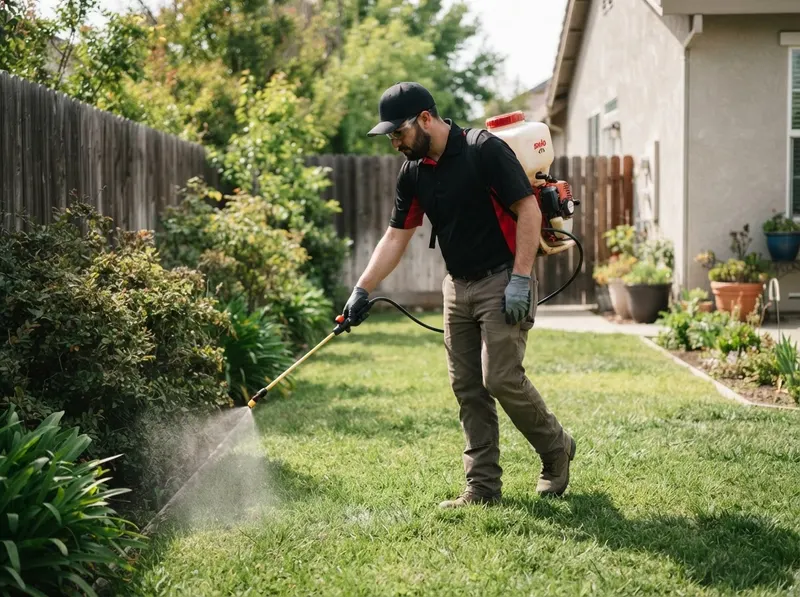
Tick and flea exterior turf sanitation stabilizes the boundary between natural riparian wildlife corridors and residential living areas throughout Sacramento County. Established properties bordering mature canopy trees in Land Park, Curtis Park, and East Sacramento consistently experience parasite pressure introduced by feral turkeys, squirrels, and raccoons traveling along old-growth property borders. In low-elevation or heavy irrigation zones such as Pocket-Greenhaven and Natomas, microclimates beneath dense groundcovers like English ivy or dwarf periwinkle maintain humidity levels above 70%, creating ideal incubation grounds for flea pupae even during 100-degree summer dry spells. Rather than deploying industrial broadcast pesticides across entire play areas, precision applications focus directly on the lower 18 inches of structural walls, fence lines, and organic litter zones where larvae shelter from dry heat.
Selecting a targeted turf sanitation barrier suits properties where domestic pets or children use the lawn daily, contrasting with whole-lot continuous fogging programs that saturate non-target surfaces. Broad-spectrum chemical fogging strips beneficial predatory insects from the soil web and causes chemical drift across patio furniture, whereas directed micro-emulsions adhere strictly to turf blades and mulch layers without producing synthetic chemical odors or staining stone flatwork. If a yard contains heavy underbrush accumulation in neighborhoods like Arden-Arcade or Oak Park, physical leaf litter reduction must accompany treatment; the trade-off requires clearing dense debris cushions so the liquid formulation reaches the thatch layer where 95% of immature fleas reside.
Pre-treatment preparation requires mowing the lawn to a standard 2.5-to-3-inch height 24 hours prior to service to expose the lower thatch layer to the application wand. Irrigation cycles must remain suspended for 4 hours following completion to allow micro-encapsulated polymers to bond securely to organic matter. For homes near the American River Parkway or Sutter's Fort State Historic Park, migratory bird and deer traffic can reintroduce hitchhiking ticks along property perimeters within 60 to 90 days. Establishing a perimeter buffer strip along rear fences neutralizes newly arriving adult ticks before they migrate across sunlit turf toward home entry thresholds.
Every job gets a firm, written price after a free on-site visit.
Tell us about your tick and flea exterior turf sanitation job in Sacramento and we'll send a clear, written quote, usually the same day.
 Orlena Pest Specialists