Sacramento features dense tree canopies and prolonged dry summer heat that drive aerial stinging insect populations toward residential structures between May and October. In neighborhoods with mature arboreal growth…
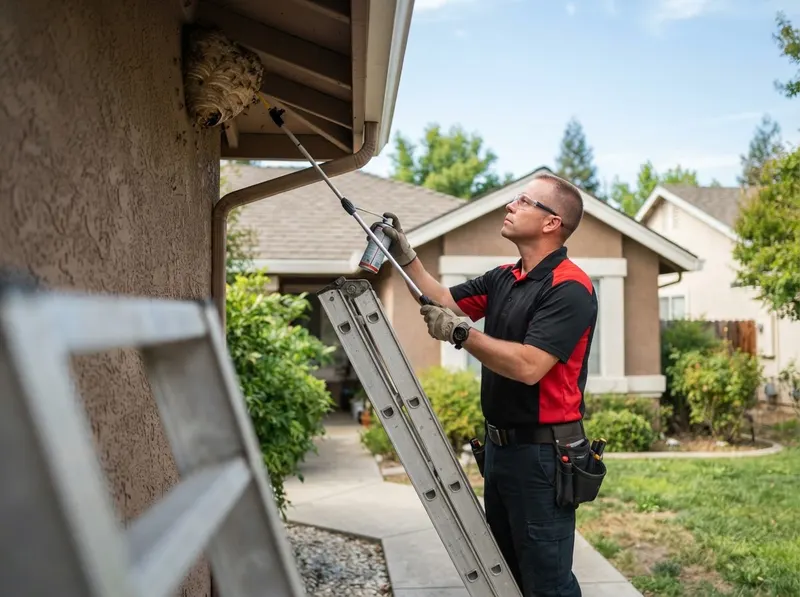
Sacramento features dense tree canopies and prolonged dry summer heat that drive aerial stinging insect populations toward residential structures between May and October. In neighborhoods with mature arboreal growth like East Sacramento, Land Park, and Curtis Park, stinging insects nest beneath deep architectural overhangs, Spanish tile recesses, and decorative wooden rafters. Left unchecked, foraging yellowjackets and aggressive bald-faced hornets exploit tiny gaps behind fascia boards to enter attic insulation, posing immediate stinging risks to families below. Orlena Pest Specialists uses focused bio-rational agents and mechanical detachment rather than continuous industrial chemical fogging, neutralizing colonies without leaving airborne chemical residues near bedroom windows or ventilation intakes.
Properties in areas with broad exposure to open agricultural borders, such as Natomas and Pocket-Greenhaven, encounter distinct pest dynamics where stinging insects establish dense satellite nests beneath aluminum patio covers and second-story rooflines. When treating two-story homes in Arden-Arcade or older bungalows in Midtown, Oak Park, and Tahoe Park, field specialists stabilize the immediate zone using targeted cold freeze sprays or non-repellent transfer compounds. Technicians physically remove the papery nests, mechanically scrape away anchor points, and apply a micro-thin, repellent-free barrier along rafter tails. This treatment stops future foundress queens from re-establishing nests on the exact same timber during spring migration.
The service follows three objective execution phases. Step one comprises a complete ground and ladder inspection to map structural nesting sites up to the roof canopy. Step two employs directed micro-aerosolization to neutralize active defensive insects directly inside the envelope of the nest. Step three executes the physical removal of comb structures followed by architectural sealing of underlying soffit gaps. If an infestation is isolated to an accessible exterior porch beam under 10 feet, physical detachment and surface neutralization resolve the issue directly. If stinging insects have penetrated behind attic vents or composite siding, technicians transition from simple canopy neutralization to full structural exclusion sealing to safeguard indoor living areas.
Every job gets a firm, written price after a free on-site visit.
Tell us about your stinging insect eave and canopy neutralization job in Sacramento and we'll send a clear, written quote, usually the same day.
 Orlena Pest Specialists